
Tuesday, April 8, 2008
9:29:00 PM CDT
Feeling Quiet
Hearing Dancing With The Stars
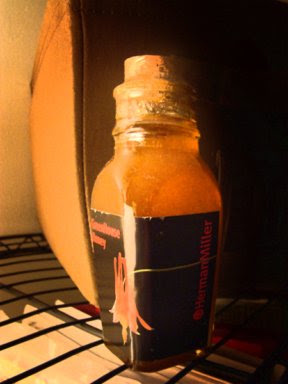
I don't feel well. It's nothing new...just another "I'm in Savannah and my allergies are trying to kill me" day. My throat is very scratchy so I thought I'd go with a tried and true home remedy to sooth it: tea with honey. My favorite honey is the Savannah Bee Company's Tupelo style honey, but I'm out of that. So, I had to go with the next best thing...Herman Miller's homemade Greenhouse Honey. Yes, you read it right, HERMAN MILLER makes honey. I love HMI for many reasons, this just adds to the list. Now, I don't know how old this bottle of honey is and I don't know what the shelf life of honey is, but it seemed reasonably safe to use because nothing funny was growing in it and it was still liquidy (as "liquidy" as honey can be). In my own sense of logic, I figured that since Herman Miller hasn't ever done me wrong by paying my bills (furniture sales) that relying on them for my healthcare (home remedy honey) doesn't seem so farfetched. However, I'm not so sure about that now. It tasted a bit "off." Not sure if that means anything or not, or maybe Michigan bees just make different tasting honey, but I think I'll just keep the bottle on my shelf as a souvenir rather than for medicinal purposes from now on. I'll leave the honey manufacturing up to the southern plantation bees rather than the northern furniture manufacturing bees.
Here's the back story on the honey. I found it on another person's blog.
A little over ten years ago, Herman Miller opened a
new manufacturing facility on a 45 acre plot in Michigan. Designed by well known “green” architect William McDonough, the facility was a model for current and future projects, promoting the company’s philosophy of sound environmental building practices. Dubbed the “Greenhouse,” it was selected by the USBGC as a pilot project for the
development of its Leadership in Energy and Environmental Design (LEED) certification process. The Greenhouse was situated in a rolling prairie and landscaped with native vegetation and flowering plants.
Sometime in the spring of 2000, paper wasps began to
show up. The wasps became aggressive, threatening workers and visitors to the facility, and eventually made their way into the building. Given the “no pesticide” policy of the Greenhouse, the caretakers of the facility were obliged to find an alternative method for eradicating the pests.
In addition to the insect problem, many of the flowers that had been planted around the site to enliven the landscape had not produced colorful blooms as expected. After speaking with some experts, the
facility caretakers brought in 12 beehives (with approximately 600,000
honeybees) to cross-pollinate the gardens. As an additional bonus, the bees took over the main food source, forcing the wasps to vacate.
And of course, the bees began to make honey.
In 2001, Herman Miller estimated the bees’ honey production to be about 4,800 pounds. While the honey is not currently for sale,
it makes a nice souvenir, as well as a symbol of Herman Miller’s environmental commitment. Going beyond responsible product development with their protocol of “Design for the Environment,” Herman Miller strives for sustainability through its entire
enterprise.


No comments:
Post a Comment